Catch every variant of your brand AI engines mention.
AI engines don't always use your exact brand name. They reach for abbreviations, former names, product names, and common misspellings. Brand Aliases map every one of those variants to your canonical name — so the matching engine counts the mention instead of missing it.
On every plan, including Free
A missed variant looks exactly like a missed citation.
When an AI answer names your brand by an acronym or an old name, a matcher that only knows your exact spelling reads it as "not cited." The mention was there — your citation rate just can't see it. Multiply that across every engine and every prompt and the gap is no longer a rounding error.
Brand Aliases close that gap. Each alias is a variant paired with the canonical brand it stands for, so the way you're actually referenced — not just the way your name is spelled in your style guide — is what gets counted.
Without aliases
"IBM was recommended for enterprise search." → not matched to "International Business Machines" → counted as invisible.
With an alias
"IBM" → maps to your canonical name → the mention is correctly counted as a citation of your brand, on every run going forward.
Add a variant, map it to you, done.
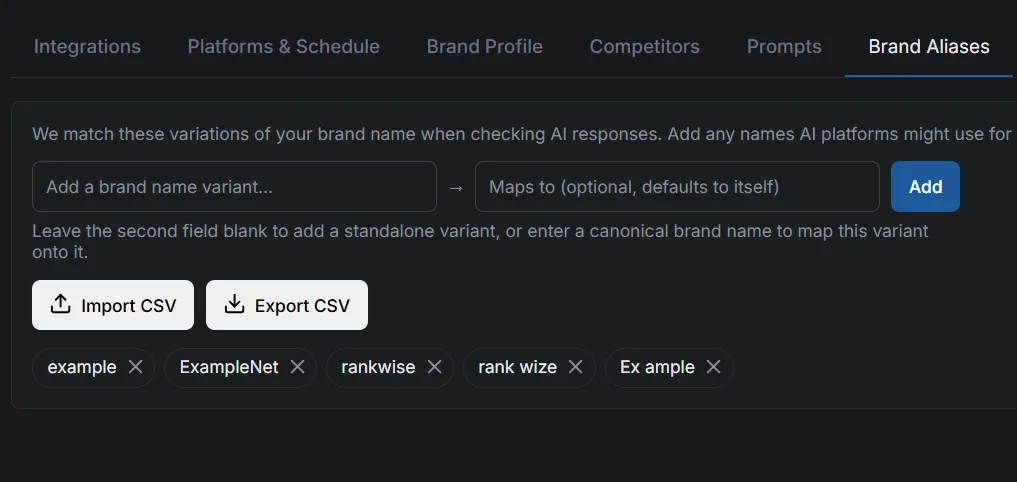
The Brand Aliases screen keeps it simple: type a variant, optionally map it to the canonical brand it stands for, and it joins your active list. Every variant you've added shows as a chip you can remove in one click.
Manage the list in bulk with Import and Export CSV — and everything in it is read by the matching engine on the next run, across every prompt and every engine you monitor.
Four ways your brand gets referenced.
These are the variants that quietly cost you citations. An alias for each one maps it back to your canonical name.
Abbreviations
Acronyms and short forms an AI engine reaches for instead of your full name — the way "International Business Machines" becomes "IBM".
Former names
What you were called before a rename or rebrand. Models trained on older content keep citing the old name long after you have moved on.
Product names
A flagship product or brand that gets named instead of the parent company — so a mention of the product still counts as a mention of you.
Common misspellings
Predictable typos and spacing variants. A dropped letter or an added space should not read as "not cited".
Four ways aliases get into the system.
Add one at a time, work in bulk, or start from the baseline Rankwize seeds for you — no spreadsheet gymnastics required.
Quick-add
Type a variant and the brand it maps to, directly on the Brand Aliases screen. One row, instantly in effect for the next run.
CSV import
Upload a list and Rankwize shows a diff preview before anything changes — exactly how many rows are adds, modifications, and deactivations — so you confirm with your eyes open.
CSV export
Download your current alias list as CSV to review it in a spreadsheet, edit in bulk, and re-import.
Seeded on setup
When you onboard, Rankwize seeds a baseline from your brand name, its no-space form, and your domain — plus any aliases you gave for competitors — so matching is not starting from empty.
CSV import is non-destructive: rows missing from your upload are deactivated, not deleted — and the diff preview shows you that before you confirm.
Global
One alias list applies across every monitoring run — there's nothing to configure per prompt or per engine.
Case-insensitive
Variant and canonical name are normalized before matching, so capitalization never costs you a citation.
Future runs forward
Aliases are read when a run executes, so they shape the next run and every run after it. Add the coverage you need before the next cycle.
Set once, applied everywhere it matters.
Aliases aren't a per-prompt setting you have to remember. The list is loaded into the matching engine on every monitoring run, so the moment a variant is in your list, it's working across all of your tracked prompts and every engine you monitor.
They take effect from the next run forward — not retroactively — so the cleanest habit is to add an alias the moment you notice a new way your brand is being named.
Brand Aliases ship on every plan, including Free.
There's no gate and no cap on aliases. Accurate matching shouldn't be a paid upsell — if AI engines reference your brand in more than one way, you can normalize every variant on any tier, from your first run.
Frequently asked
What's a brand alias?
A brand alias is a variant of your brand name paired with the canonical name it maps to. AI engines do not always use your exact brand name — they reach for abbreviations, former names, product names, or misspellings. An alias tells Rankwize's matching engine that every one of those variants means you, so a mention written any of those ways is correctly counted as a citation of your brand rather than missed.
When should I add an alias versus leave it?
Add an alias whenever a real reference to your brand could be written in a form the matcher would not recognize as you — an acronym, a former name, a flagship product, a frequent misspelling. If a variant never actually appears in AI answers, there is nothing to catch and no reason to add it. The goal is coverage of how you are really referenced, not an exhaustive dictionary of every possible spelling.
Do aliases affect historical runs or only future ones?
Future runs only. Aliases are read at the moment a monitoring run executes, so they shape how that run and every run after it matches mentions. Past runs already stored their results and are not re-scored retroactively. Add the aliases you need before the next run, and the coverage applies from that run forward.
Can I import aliases in bulk?
Yes. Upload a CSV and Rankwize shows a diff preview before committing anything — it tells you how many rows will be added, how many modified, and how many deactivated. Confirm the preview and the changes apply. You can also export your current list to CSV, edit it in a spreadsheet, and re-import.
Are aliases case-sensitive?
No. Matching is case-insensitive — both the variant and the canonical name are normalized before comparison, so "acme", "ACME", and "Acme" are treated the same. You do not need to add separate rows for capitalization differences.
What happens if two aliases point to the same brand?
That is expected, not a conflict. The alias table is a many-to-one lookup: any number of variants can map to a single canonical brand name, and all of them resolve to that brand. Exact duplicate rows are prevented automatically, but multiple distinct variants pointing at the same canonical name is exactly how full coverage is built.
Aliases feed the same matching engine behind AI Citation Monitoring and Share of Voice.